Be yourself; Everyone else is already taken.
— Oscar Wilde.
This is the first post on my new blog. I’m just getting this new blog going, so stay tuned for more. Subscribe below to get notified when I post new updates.
Be yourself; Everyone else is already taken.
— Oscar Wilde.
This is the first post on my new blog. I’m just getting this new blog going, so stay tuned for more. Subscribe below to get notified when I post new updates.
My main takeaway from rereading my blog posts is that conducting, reading, and evaluating research is a process. I learned so much in this class including how to: find information, evaluate research, write a literature review, and most importantly, how to structure and write a research proposal. One of my many takeaways is that research is the backbone of social work practice and that my ongoing professional development should include paying attention to the research. I will think about how research informs current trends in treatments, interventions, and programs. I will continue to read the Journal of the National Association of Social Workers, and in the future, I will make an effort to attend continuing education classes, lectures, seminars, and conferences.
At the onset of this class, I was hoping to learn the basics of how to access research, evaluate it, and incorporate research into a literature review and paper. I was intimidated by the prospect of doing these things but this class broke down the literature review and research proposal into manageable pieces. The lectures and textbooks worked together to guide me through the process.
Looking back at my blog posts highlights the full scope of writing a research proposal and how each step has a specific process and set of requirements. I am very glad I did all of the readings and took notes during the lectures. I learned that I have the patience to learn something new and the stamina to sit and write for 2 -3 hours at a time. At the beginning of the school year, I was worried about learning APA formatting. So, in September I started using Mendeley to organize my sources and manage and format my bibliographies and citations. At the beginning of this semester, and in preparation for this class, I purchased a hard copy of the current APA Publication Manual so I could look up formatting and citation questions. I spent a lot of time on my literature review so I would become more comfortable doing thorough searches. I loved using the library databases and I learned how to request articles. I think going forward I will feel more confident writing research papers because now I have an understanding of the process and some experience!
My final thought is based on a reading from my human behavior class. The last chapter we had to read included a section on translation research. I had never heard this term before and it is a process “involving overcoming all of the obstacles that prevent the application of research findings beyond academic circles and professional journals”, and how to incorporate findings into real-life practice (Marsiglia & Kulis, 2016). I think this goes along with the question I asked you in class about who reads all of the journal articles. I want to know more about translation research and how research makes its way into practice.

What does ethical research mean to you before today’s lecture and after today’s lecture and discussion? What insights did you gain from the material? How does your understanding of the ethical issues in research affect your thinking about the implementation of the proposal?
Prior to last week’s lecture and readings, my thoughts on ethical research were about plagiarism, conducting original research and generally about not causing harm to research subjects. I thought of ethics in terms of being honest. After the lecture and readings, I can see that there are many layers to plagiarism and conducting original research. All of the videos we watched highlighted different ethical research scenarios. I also learned there are many other ethical issues such as cultural and gender bias, which are related to how a study is designed and what survey instruments are used. Our class conversation about authorship brought up ethical issues related to gender, and power dynamics between students and professors.
Two macro ethical issues I had not thought about previously are related to what types of research gets funded and how research results are interpreted and misinterpreted. Do studies involving certain types of populations, proposed by certain types of researchers attract more than their fair share of funding? At the beginning of this class we also talked a lot about how research is used and how results can be taken out of context or misconstrued. I think this is a huge ethical issue and in today’s political environment, I think a lot of people are skeptical about research results that don’t directly relate to or support their interests.
In regards to implementing my proposal, I think that my approach is ethical, and that the participants would benefit from having access to a social worker. However, I think it would be somewhat of a hardship to withdraw these services at the end of the intervention period. In an ideal world, there would be an ongoing relationship with a local agency, Dominican and the SLF so services could continue. Also, if I was actually implementing the proposal, I would learn more about why there are no regular on-site social services available to SLF residents, or if this is even true across all SLFs in IL. Based on what I know however, I think the underlying issue is funding and perhaps the misconception that assisted living provides everything a person needs to stay safe and healthy.
Blog #8 Self Efficacy and the Final Research Paper
The final research paper is due in a couple of weeks. It is a major paper which requires planning, writing, and thoughtful integration of the ideas we covered during the entire semester. How are you approaching the completion of this task? What is your plan? How do you plan to complete the assignment in a timely manner? What are the specific tasks that you would need to do to get the work done? What’s your strategy and plan for the completion of this final paper?
This has been my plan:
First, I started early, and by early, I mean as soon I my literature review was done. First I did another literature search related to my methods and scales. I was concerned about finding a good scale and I found and read several articles, which in turn lead me to a handful of scales. This was time consuming but I enjoyed searching for a survey that made sense for my research proposal.
The second part of my plan was doing all of the assigned reading. The Rubin and Babbie text was very helpful and I used it as a guide when drafting my paper. I made a lot of little notes in the book and also made several pages of notes with page numbers that I could refer back to while drafting my paper.
The third part of my plan was taking good notes during class. The majority of the information in this class has been new to me so taking notes helped me understand and retain information. I refer back to my class notes often.
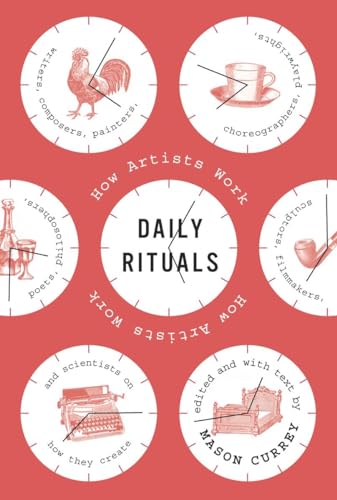
The fourth strategy I used was talking about my research proposal all of the time. I take a lot of walks with my husband and my cousin and I talked about my paper, and asked my cousin a lot of questions. Last year I read this great book about how writers and artists organize their days and about 90% of them took a daily walk to contemplate their work. I love this book!
This leads to my last strategy, which was simply giving myself time to think about what I was doing. So, from the very beginning of the semester I’ve felt this paper hanging over my head. I knew I had to have a plan because I am too busy with work, family, volunteer work and random consulting jobs I take to help pay my tuition. Starting early and incorporating class notes and the readings gave me the time to think and reflect and ask myself and others questions.
Finally, several of my past jobs have included the words “project manager”. I am good at planning and getting things done in an organized fashion. At least most of the time.

What are your thoughts on research designs after tonight’s class? How important is identifying an appropriate research design for your study? What types of research designs are you considering for your study and why? Notate a research design that is consistent with the goals of your study.
After our class lecture and reading through all of the options in Rubin and Babbie text I realized that I had many options. I was tempted a few times to change my research proposal to match a research design that sounded maybe more interesting, more fun, more realistic. I wrote notes as I read through Chapter 12 so I could go back and review them once I really had to make a decision about my design.
I looked at the one-group pretest – post-test, but then read that is does not account for several threats to internal validity so I moved on. I also considered the pretest-post test control group design but I made a note that maybe it was too rigorous and not the best match for my research proposal. When I read the description for the nonequivalent comparison groups design, I wrote, “yes, this seems applicable!” I started to think through how I could identity two similar groups. I also read that this was similar to the pretest post test control group design but without the random assignment. So I decided to choose this design.
This is the shorthand notation and customized by adding the third row:
Group 1 O1 X O2
Group 2 O1 O2
Group 3 O1 X O2
I talk about my research proposal whenever I see my cousin who is working on a research project for her PhD in public health. We’ve taken several socially distanced hikes over the past month and we talk about my proposal and her research. After I described what I was doing she suggested I add the third row – so Group 1 gets the intervention with a social worker, Group 3 gets no intervention and the Group 3 will get an information packet about social service resources. This will provide me more data about the impact of the intervention.
I made myself stop worrying about picking the perfect design and just commit and think through the research protocol and survey instrument(s). As I’ve written in previous posts, I remind myself often that this is a learning experience.

As a researcher, which particular research methods (quantitative, qualitative, or a combination) do I tend to gravitate towards and why? Do I think it’s important to recognize the biases in the choice of the research method? Why? What could determine the use of a particular research method?
I think my biases at this point are based on my skill and comfort level with quantitative and qualitative research methods. If I was equally knowledgeable about both methods, I would of course pick the one most appropriate for my research question. At this time, I think I might only consider topics requiring a qualitative approach. I understand that qualitative studies can be complicated but I think they are generally easier to conceptualize and explain. I would have a hard time designing a quantitative study, unless it was a very straight-forward one. However, based on my previous blog post, I think it is important to not shy away from statistics and numbers, as they can often make the most persuasive and factual case when trying to provide support for a research question.
Also, I think many aspects of qualitative studies work well with social work research questions. I like that they can be exploratory and involve case studies and focus groups. I like that they can focus on specific individuals and using a detailed survey instrument with a small sample can provide rich data. According to Rubin and Babbie, qualitative studies “are more likely to tap the deeper meanings of particular human experiences and generate theoretically richer observations that are not easily reduced to numbers”.
These are my thoughts and feelings about statistics and why I think and feel this way about statistics. I think as an academic subject, statistics can be intimidating. This is dependent on past experience, educational background and overall comfort with math. More on this last point, below. I took statistics in the early 1990’s and I don’t remember what I learned. How did we learn stats without access to computers? The only thing that stayed with me for a long time, is that I don’t like stats. I think think a lot of people have similar experiences and then avoid statistics or decide that they can be avoided. Also, I think a lot of people decide that if they are not good at math, they will have the same experience with statistics. I think there is some overlap with skill sets but that stats are a separate discipline and can be learned without high, high level math skills.
These are also my thoughts about what can we do as a class (or individuals) to appreciate statistics more fully. I think as students we can spend as much time as possible with the Success at Statistics workbook. I think it provides a good step by step approach with lots of examples and illustrations. I love that the book uses a little humor to make the subject more palatable. As a class, I think we can work hard to be prepared for class so that we can all share what we know and not get bogged down in material that we can pick up from the book. I think class time is great for examples and for explaining more complex concepts. I learn the concepts the best by using easy to relate to examples.
Finally, I answer the question, what is purpose of statistics Statistics help us understand the world. Now more than ever we are either reading articles or listening to news filled with statistics related to the Covid-19 pandemic. I think it’s important to reflect back on what we learned on the first day of class about how to evaluate research and stats. I think we should be able to trust our political leaders to repeat only facts and rely on sound research when deciding what to share with the public, but I know this is not the case. Statistics are helping me make sense of what is going on in the world right now. Another important purpose of statistics is of course related to research. Stats help us tell a story and build a case for our hypotheses.
Q: What are my current biases with my research topic? Why is it important to be aware of my biases when writing a literature review? Do I think my biases could affect the conclusions that I arrive at in my literature review? Moving forward, what do I need to do to address these biases that I’m aware of in my paper?
My biases are the following: I believe that the answer to my research question is yes, the provision of on-site social services will improve quality of life, social engagement, and autonomy of older adults living in assisted living facilities (ALFs). Early in the process I needed to be aware of this to make sure I wasn’t choosing articles that seemed to support this conclusion.
In my review, I focused on several overall quality of life indicators in assisted living and on situations that cause stress and hardship, such as transitioning to an ALF. I also looked at the different roles social workers could potentially play in an ALF settings. Finally, I read articles about moderating and mediating factors such as social relationships, family dynamics, health, and staffing.
I am being careful to make sure any biases I have do not influence my literature review conclusions. I’ve had to make sense of what the literature is telling me about my research question. There are many interrelated factors:
I’ve realized there is not going to be a straight path to finding an answer to my research question.
Moving forward I need to focus on my methods. I think it is fair to conclude through observation that many residents of ALFs could use some assistance that would improve general quality of life. However, I need to make sure my methods and in particular my survey instrument allows for other conclusions on how best to support this population.
So, my goal is to avoid:

What gains/new insights/perspectives have you made about the uses of research to your future social work practice?
How relevant is research to social work practice? What could research potentially do?
How should social workers really think about the role of research?
Research is a place to go for answers and a way to share information. It can be used to build a case for a policy change or a new program. Research is also a path to being impartial and base social work practice on evidence instead of emotions and doing what “feels right”. Research is a way to build support for the field.
Do social workers have to choose between doing research and working for their clients? Are these two issues distinct or are they different sides of the same coin?
Social workers may spend 90% of their time working with clients but they will likely include some form of research in their practice. Examples are researching new interventions, programs, benefits, drug side effects or housing options for a discharge plan. Social workers may be part of a research study or provide data to a researcher. I think they are different sides of the same coin but can vary greatly depending on the type of social work practice.
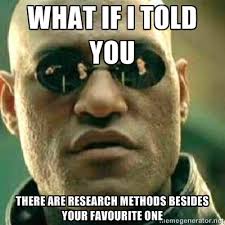
My meme.
I understand the concept of research and its importance. I worked for two large non-profits that based its programs on research and evidence-based practices. I currently do a lot of research – but what I would call research with a small “r”. Now I’m learning how to do a more rigorous academic type of research and learning about its implications for social work practice.

Blog Post #1: Describe your experience or experiences with research as a subject. How do you feel about research? Do you see any benefits and/or downsides in using research in social work practice? What are your fears and concerns, if any? How do you think this will impact upon your motivations and work for this course?
My Thoughts: I’m looking forward to learning more about research but also feeling a little intimidated. I worked for two non-profits IFF (https://iff.org/) and CSH (https://www.csh.org/) that used research and evidence based practices to propose programs and policy changes, implement programs and most importantly influence systems change. Evidence was the most powerful and persuasive tool when talking to decision makers about why they should support a particular initiative with time/money/political capital.
I think evidence based practices are at the core of social work practice but they must be relevant to the individual or population being served. I think one downside to using research is how it is communicated. It can sound to impersonal or technical but these issues can be mitigated by basing your work on research and explaining why you think a particular approach is relevant. Instead of saying, “the research shows this is the best approach”, you could say, “the research shows this is a good approach and this is why”.
My only fear at this point is learning the correct research protocols. The “How to Write an Empirical Research Paper in Psychology”, was intimidating. However, I took note that the syllabus said “review” so I worked through the first few pages trying and then read the remainder of the document.
Do you have what it takes to write an effective literature review? What particular strengths would you build upon and what are the areas that you believe need attention when you start to develop the literature review?
I think I have what it takes in terms of curiosity and a true interest in my topic. I like to read and look through all of the various articles. I also have a slightly outdated library science degree so I enjoy using the library resources in addition to Google Scholar. I understand the overlap but like going right to the databases and using the search features. I think the areas that need attention are organizing my paper and making sure I have a clear outline before jumping in. Chapter 7 of the Babbie text gave me some ideas about conceptualization and how to determine my research variables.
My intervention: social work supports
My mediating variables: staffing levels, family supports, health of older adult
My dependent variables: satisfaction, health.. and maybe one more.
I’m still concerned about doing this the “right” way and I need to focus on doing a good job but also being comfortable with the learning process and maybe not getting it all just right. There are so many concepts to synthesize. Am I building a “major claim”, that older adults living in affordable assisted living will experience higher levels of health, socialization and satisfaction if they receive social work supports”?
Final thought – there are so many steps in the Machi text!

Have a WordPress.com account? Log in now.

